Maximizing Rental Yields in Singapore: Most Durable Floorings for Landlords (2026 ROI Guide)
July 21, 2026
Age-Proofing Your HDB: Slip-Resistant Flooring and the EASE Programme (2026 Guide)
July 23, 2026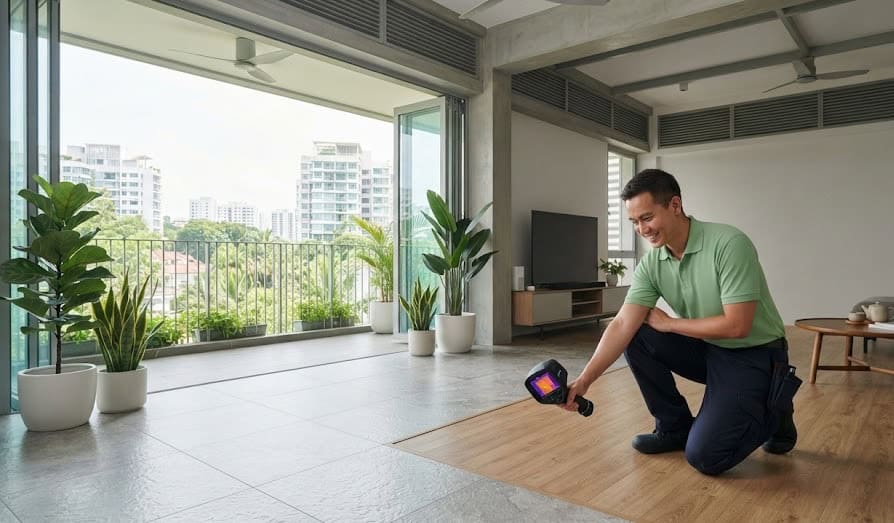
Table of Contents
Beating Singapore’s Heat: The Best Cooling and Moisture-Resistant Floorings
Singapore’s tropical climate presents two continuous architectural challenges: intense ambient heat and high atmospheric humidity. Elevated urban heat island (UHI) temperatures across densely built HDB estates and condominium precincts, combined with relative humidity levels hovering between 80% and 95% year-round, create severe thermal stress inside residential interiors. Running air-conditioning split units continuously across multiple rooms leads to soaring monthly utility bills.
Homeowners seeking sustainable interior solutions are turning to passive cooling techniques. While window blinds and low-emissivity glass manage solar heat gain, floor surfaces play an equally significant role in regulating indoor thermal energy. Flooring materials cover vast horizontal surface areas within living halls and bedrooms. The wrong material acts as a thermal insulator that holds ambient daytime heat long into the evening or absorbs atmospheric moisture until planks warp and buckle.
Identifying effective cooling flooring in Singapore requires examining material thermal conductivity, thermal effusivity, and hygroscopic stability. Whether you are fitting out a new BTO flat or renovating a resale apartment, selecting the best flooring for hot weather creates a refreshingly cool underfoot environment while preventing humidity-driven moisture damage.
The Physics of Thermal Conductivity and Touch Perception
Understanding why certain floors feel cool to bare feet while others retain warmth requires analyzing two distinct physical properties: thermal conductivity ($\lambda$) and thermal effusivity ($b$).
1. Thermal Conductivity ($\lambda$, W/m·K)
Thermal conductivity measures a material’s capacity to conduct heat energy across its mass. High thermal conductivity materials—such as glazed porcelain tiles ($\approx 1.3 – 1.5$ W/m·K) and stone plastic composite vinyl ($\approx 0.25 – 0.35$ W/m·K)—transfer indoor heat rapidly to underlying concrete subfloors. When an air conditioner turns on, high-conductivity floors drop to target temperatures within minutes, reducing the cooling load on compressor units.
2. Thermal Effusivity ($b$, J/m²·K·s$^{1/2}$)
Thermal effusivity dictates how “cool” or “warm” a surface feels upon initial skin contact. It measures the rate at which a surface absorbs thermal energy from human skin. High-effusivity materials draw heat away from bare feet instantly, creating an immediate sensation of cool relief without requiring heavy air conditioning.
3. Hygroscopic Expansion Mechanics
Atmospheric moisture creates structural challenges for organic floorings. Unengineered solid timber cell walls absorb ambient water vapor during humid rainy months, causing wood fibers to swell perpendicular to the grain. This expansion exerts mechanical pressure against neighboring planks, leading to cupping (edges raising higher than the center), crowning (centers bulging upward), and joint buckling. Selecting a dimensionally stable, humidity resistant wood floor requires cross-laminated engineering that neutralizes these natural forces.
Comparative Analysis of Indoor Cooling & Moisture-Resistant Materials
Evaluating indoor flooring performance requires balancing thermal dissipation against moisture resistance, walk comfort, and aesthetic warmth across your home layout.
1. Glazed Porcelain Tiles: Maximum Passive Dissipation
Glazed porcelain tiles represent the traditional benchmark for passive cooling in tropical architecture. Manufactured from dense kaolin clay fired at temperatures exceeding 1,200°C, porcelain tiles deliver exceptional thermal performance:
- Ultra-High Thermal Conductance: Rapidly dissipates absorbed ambient room heat down into structural concrete floor slabs.
- Zero Water Absorption (<0.5%): Completely impervious to humidity spikes, standing water, and tropical dampness.
- High Thermal Effusivity: Feels cool to bare feet even during peak mid-afternoon heat waves.
2. Stone Plastic Composite (SPC) Rigid Core Vinyl: Balanced Comfort & Water Immunity
SPC vinyl combines the high thermal density of natural limestone powder with the resilience of PVC polymer resins. SPC offers an excellent balance between passive cooling and comfortable underfoot resilience:
- 100% Waterproof Rigid Core: Limestone-PVC cores will never swell, cup, or delaminate under high relative humidity.
- Efficient Thermal Transfer: Conducts cooling energy efficiently while providing a softer, quieter footfall than ceramic tiles due to integrated IXPE foam underlayments.
- Seamless Click-Lock Joints: Tight joint seams prevent humid air from filtering down beneath planks to create hidden subfloor moisture pockets.
For homeowners prioritizing zero moisture absorption and complete protection against tropical humidity spikes, installing high-performance waterproof flooring solutions ensures subfloors remain structurally stable without swelling.
High-Density Technical Comparison Matrix
Evaluating thermal cooling efficiency and moisture stability requires analyzing physical conductivity, effusivity sensation, and dimensional expansion coefficients across candidate flooring options.
The technical comparison table below evaluates major residential flooring materials against thermal cooling and humidity parameters for Singapore homes:
| Flooring Material | Thermal Conductivity ($\lambda$, W/mK) | Underfoot Thermal Touch Sensation | Moisture Absorption Rate (%) | Dimensional Stability Index | Aircon Cooling Speed Efficiency | Recommended Flat Zone |
|---|---|---|---|---|---|---|
| Glazed Porcelain Tiles | 1.30 – 1.50 W/mK | Very Cool (Rapid heat draw) | <0.5% (Impervious) | 10 / 10 (Zero expansion) | Optimal (Cools room instantly) | Living Halls, Kitchens, Balconies |
| SPC Rigid Core Vinyl (5mm) | 0.25 – 0.35 W/mK | Refreshingly Cool / Neutral | <0.1% (Impervious) | 9.8 / 10 (High stability) | Very Good (Quick transfer) | Living Halls, Bedrooms, Kitchens |
| Multi-Ply Engineered Wood | 0.15 – 0.20 W/mK | Warm / Neutral (Comfortable) | 2.0 – 4.0% (Core stabilized) | 8.8 / 10 (Cross-grain stable) | Good (Balanced insulation) | Bedrooms, Living Halls |
| High-Pressure Laminate (AC4) | 0.12 – 0.15 W/mK | Slightly Warm (Insulating) | 5.0 – 8.0% (HDF core risk) | 6.5 / 10 (Joint wax dependent) | Moderate | Bedrooms, Study Rooms |
| Solid Hardwood Timber | 0.13 – 0.17 W/mK | Warm (Natural insulator) | 8.0 – 14.0% (High absorption) | 4.0 / 10 (High warping risk) | Moderate | Bedrooms Only (Low humidity) |
Matching your flooring selection to room orientation and thermal exposure ensures your living space remains comfortably cool without risking humidity-driven material damage.
Indoor Wood Solutions: Engineered Wood for Humidity Stability
Homeowners who appreciate natural timber aesthetics often worry about the performance of real wood in Singapore’s tropical climate. Traditional solid hardwood planks—such as solid Teak, Oak, or Balau—consist of a single thick piece of natural timber. Because real wood is naturally porous, unengineered solid planks swell across their width when relative humidity climbs above 80%, leading to tight compression ridges and unsightly gaps between floorboards during drier air-conditioned periods.
Engineered wood flooring solves this dimensional instability through advanced structural engineering. Rather than relying on a single solid timber block, engineered planks feature a multi-ply cross-laminated construction:
- Authentic Hardwood Surface Layer: A 2mm to 4mm slice of natural European Oak, American Walnut, or Teak hardwood forms the top visual surface. This real wood layer provides natural grain variations, organic warmth, and smooth underfoot texture.
- Cross-Laminated Plywood Sub-Core: Below the top veneer, 5 to 9 individual layers of high-density Birch or Hevea plywood are bonded together using waterproof adhesives under extreme pressure. Each underlying layer is placed at a 90-degree right angle to the layer above it.
- Grain Shear Balance: Because wood fibers expand along their grain width rather than their length, alternating the grain direction of each core ply cancels out internal expansion forces. When atmospheric humidity surges during rainy months, the cross-grained core counteracts directional swelling.
For homeowners who desire the authentic warmth and prestigious grain texture of real hardwood without risking seasonal cupping or gap formation, installing high-stability engineered wood flooring provides a dimensionally stable solution engineered specifically for high-humidity tropical climates.
This cross-grain core architecture creates a true humidity resistant wood floor that maintains tight, flat seams throughout Singapore’s wet and dry seasonal shifts.
Outdoor Thermal Management: Balcony & Patio Composite Decking
Managing heat in Singapore homes extends beyond interior rooms to include exterior balconies, open patios, and roof terraces. Unprotected concrete balcony slabs and dark porcelain tiles absorb direct tropical solar radiation throughout the morning and early afternoon. This stored thermal energy acts as a giant radiator, transferring heat through living room glass doors long after sunset.
Installing wood-plastic composite (WPC) decking over outdoor balcony slabs creates a ventilated thermal barrier that blocks direct solar heat gain:
- Sub-Deck Ventilation Air Channels: Outdoor composite decking is installed on raised aluminum sub-frame joists, creating a 30mm to 50mm air gap beneath the deck surface. Ambient breezes pass through this sub-deck cavity, dissipating radiant heat before it reaches the concrete floor slab.
- UV-Reflecting Polymer Cap Layers: Advanced co-extruded composite decking features protective polymer caps containing infrared-reflecting pigments. These cap layers reflect up to 40% of solar heat radiation, keeping outdoor deck boards cool underfoot.
- Zero Humidity Rot or Termite Damage: WPC formulations combine recycled hardwood fibers with high-density polyethylene (HDPE) resins, creating an outdoor surface that will never rot, splinter, or absorb monsoon rainwater.
To prevent balcony concrete slabs from acting as thermal heat sinks that radiate daytime heat into adjacent living halls, installing ventilated outdoor decking services creates a protective thermal barrier while expanding usable outdoor leisure space.
Selecting materials with high thermal conductivity ($\lambda \ge 0.25$ W/mK) and high thermal effusivity—such as glazed porcelain tiles or SPC rigid core vinyl—allows indoor room air to cool up to 35% faster when air conditioning is turned on. The floor absorbs heat from ambient air rapidly, reducing the compressor runtime needed to reach target room temperatures (e.g., 23°C) and lowering monthly electricity consumption.
Passive Thermal Dynamics & Aircon Recovery Time
The rate at which a room retains its cool temperature after air conditioning turns off depends on the thermal mass of its flooring. Dense, high-effusivity materials act as thermal storage units, absorbing cool energy during air-con operation and releasing it slowly back into the room once the unit is switched off.
Frequently Asked Questions About Cooling and Moisture-Resistant Flooring
What is the best flooring for hot weather to lower my aircon electricity bill?
Glazed porcelain tiles and Stone Plastic Composite (SPC) rigid core vinyl are the most effective cooling floorings for hot weather in Singapore. Both materials possess high thermal conductivity and thermal effusivity, drawing heat away from living spaces and cooling rapidly when air conditioning is turned on.
How does engineered wood prevent humidity warping compared to solid timber?
Engineered wood utilizes a multi-ply cross-laminated core beneath its real wood top veneer. Each underlying plywood layer is placed at a 90-degree right angle to the adjacent layer. This cross-grained construction neutralizes natural wood movement, preventing planks from warping, cupping, or buckling during high-humidity periods.
Will SPC vinyl feel warm or cool under bare feet in a Singapore BTO flat?
SPC vinyl feels refreshingly cool and neutral under bare feet. Because its rigid core contains up to 60% natural limestone powder, it conducts thermal energy efficiently while providing a softer, more comfortable underfoot feel than hard ceramic tiles.
Why does natural timber cupping happen during Singapore’s monsoon season?
Timber cupping occurs when unengineered solid wood absorbs atmospheric water vapor from humid air (80% to 95% RH). As the bottom or edges of the wood board absorb more moisture than the top surface, uneven expansion forces the board edges upward, creating a hollow, cupped shape across the plank.
How does balcony composite decking reduce heat transfer into the living room?
Composite decking is elevated on aluminum joists, creating a ventilated air gap above the concrete balcony slab. This sub-deck air gap prevents direct solar radiation from heating the concrete floor, stopping heat from radiating through sliding glass doors into your living room.
Optimize Your Home’s Thermal Comfort with Expert Flooring Solutions
Beating Singapore’s tropical heat and relentless indoor humidity requires a thoughtful, physics-based approach to floor material selection. By choosing materials engineered for high thermal conductivity, low thermal retention, and cross-laminated moisture stability—such as glazed porcelain tiles, SPC rigid core vinyl, and engineered wood—you create a cool, comfortable sanctuary while protecting your home investment against seasonal humidity damage.
When you are ready to review physical material samples, measure floor surface temperatures, or request a professional on-site thermal consultation for your upcoming home renovation, specialized flooring experts are ready to guide you through every choice.
Take the next step toward a cooler, energy-efficient home. Request your complimentary flooring sample kit or book a safety-focused site assessment consultation today.