Age-Proofing Your HDB: Slip-Resistant Flooring and the EASE Programme (2026 Guide)
July 23, 2026
Flooring Guide for New HDB Plus & Prime BTO Flats (2026 Updates)
July 28, 2026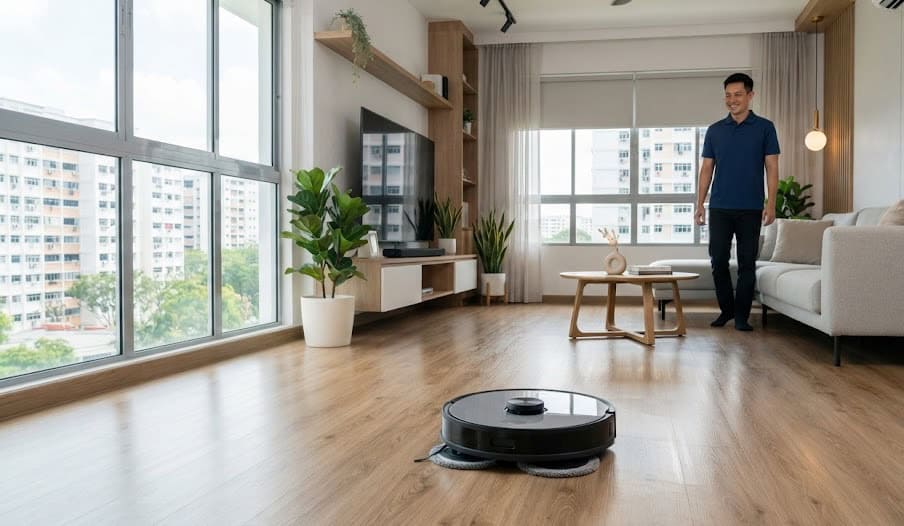
Table of Contents
Robot Vacuums & Smart Homes in Singapore: Which Floorings Hold Up Best?
The rapid adoption of all-in-one robot vacuum and mop docking stations across Singapore apartments has transformed daily domestic housework. Modern flagship smart cleaning units (such as Roborock, Dreame, Ecovacs, and Narwal) no longer just sweep up dust. They wash their own mop pads with 60°C hot water, apply active downward pressure to scrub sticky floor stains, spin dual microfiber pads at 180 RPM, and automatically navigate across living rooms twice daily.
While these automated appliances deliver unmatched lifestyle convenience for busy working professionals, they introduce mechanical friction and moisture stress to residential floor surfaces. In a typical Singapore home, a robot mop runs 300 to 365 days a year, repeatedly applying damp pads and rubber drive wheels along identical floor travel paths. Homeowners are increasingly concerned about micro-scratches, seam swelling, and water damage caused by continuous automated cleaning.
Selecting a true robot vacuum friendly flooring material requires evaluating surface hardness, water absorption rates, joint seam integrity, and wear-layer density. If you are renovating a new BTO flat or upgrading an existing condominium floor, understanding how automated cleaning technology interacts with different materials ensures your investment remains pristine for years to come.
The Mechanical Stress Profile of Modern Robot Mops
To understand why certain floor materials fail under robot cleaning while others thrive, flooring specialists analyze the physical forces exerted by modern smart cleaning units:
- Downward Scrubbing Pressure (6N to 12N): Advanced robot mops utilize internal pneumatic springs or counterweights to push spinning pads firmly against the floor with 6 to 12 Newtons of force. This downward pressure breaks up dried liquid spills, but forces moisture into unsealed micro-joints between floor planks.
- High-Speed Rotational Friction (180 RPM): Dual spinning microfiber mop pads rotate at speeds up to 180 revolutions per minute. If fine silica dust or outdoor shoe grit becomes trapped beneath the pads, this spinning motion acts like an orbital sander, dulling soft polyurethane varnish coats.
- Continuous Micro-Moisture Exposure: Automated docking stations re-wet mop pads continuously during a cleaning run. Unlike manual mopping—where a floor dries within minutes—robot mops leave a constant, thin water film along plank seams every single day.
- Drive Wheel Traction & Grit Dragging: High-traction rubber tread wheels carry the 4kg to 5kg weight of the robot unit. When wheels roll over coarse sand particles dragged in from balconies, the concentrated wheel load can press grit into softer floor finishes.
Matching your smart home appliance with high-performance scratch resistant flooring in Singapore prevents premature surface wear and preserves your floor’s factory sheen.
Moisture Mechanics & Seam Swelling: Evaluating Material Resistance
Different flooring materials respond in starkly different ways to daily moisture exposure and mechanical brush contact. The primary point of failure on floating floor installations is not the center of the plank, but the click-lock seam edge where water can penetrate into core materials.
1. Stone Plastic Composite (SPC) Vinyl: The Gold Standard for Smart Homes
Stone Plastic Composite vinyl represents the undisputed top choice for homeowners deploying automated robot vacuum and mop systems. Engineered with a dense rigid core combining 60% natural limestone powder, PVC resin, and thermal stabilizers, SPC offers complete structural immunity to water.
- Zero Water Absorption: The limestone-PVC core material is 100% waterproof. Even if a robot mop dock leaks or stalls on a plank seam while releasing water, the SPC core will never swell, cup, or delaminate.
- Heavy Commercial Wear Layers: Premium 5mm SPC planks feature a transparent 0.5mm or 0.7mm ceramic-bead wear coat. This ultra-hard top coating achieves high scratch resistance, easily tolerating 180 RPM spinning pads and rubber drive wheel friction.
- Drop-Lock Seam Seals: Precision-milled click joints keep planks locked tight under thermal changes, preventing standing water droplets left by mop pads from filtering down to subfloor screeds.
For homeowners investing in smart cleaning appliances who want total peace of mind against water seepage at click-lock joints, choosing certified waterproof flooring solutions protects subfloors from daily robot mop pad moisture.
When evaluating options for a high-traffic smart home, installing high-density vinyl flooring provides an ideal combination of impact absorption, water resistance, and acoustic dampening.
2. High-Pressure Laminate (HPL): High Scratch Resistance with Seam Cautions
High-Pressure Laminate delivers outstanding surface hardness due to its aluminum oxide clear coat (rated AC4 or AC5 for commercial wear). It resists scratch marks from robot side-sweeping brushes and drive wheels exceptionally well. However, its high-density fiberboard (HDF) core is made of compressed wood fibers.
If you use a robot mop on laminate floors, select models with wax-sealed hydrophobic joint edges and configure your smart home app to set mop water discharge to “Low” or “Slightly Damp” to prevent edge swelling along plank seams over time.
High-Density Technical Comparison Matrix
Identifying the best floors for robot mops requires comparing moisture resistance, mechanical surface hardness, and seam vulnerability across popular residential materials used in Singapore homes.
The technical comparison table below evaluates major flooring categories against automated robot vacuum and mop performance parameters:
| Flooring Material | Moisture Tolerance Grade | Scratch & Wear Resistance | Robot Mop Compatibility Score | Joint Swelling Risk | App Water Calibration Setting | Overall Category |
|---|---|---|---|---|---|---|
| SPC Rigid Core Vinyl (5mm) | 100% Impervious (Zero absorption) | 0.5mm – 0.7mm Wear Layer (High) | 10 / 10 (Optimal) | Zero Risk | High / Maximum Dampness | Top Pick for Smart Homes |
| Glazed Porcelain Tiles | 100% Impervious (Grout sealed) | MOHS Hardness 7+ (Extreme) | 9.5 / 10 (Excellent) | Zero Risk (Sealed grout) | High / Maximum Dampness | Top Pick (Hard Surface) |
| High-Pressure Laminate (AC4/AC5) | Moderate-High (Wax joint protection) | AC4 / AC5 Rating (Very High) | 8 / 10 (Good) | Low – Moderate (Seam edge risk) | Low – Medium Dampness | Compatible (Dry Mode Focus) |
| Engineered Hardwood | Moderate (Urethane factory seal) | UV Acrylic / Lacquer (Moderate) | 6.5 / 10 (Conditional) | Moderate (Micro-bevel seams) | Low Dampness Only | Use Caution |
| Solid Timber & Wood Parquet | Porous (Hygroscopic wood core) | Polyurethane / Varnish (Soft) | 4 / 10 (High Risk) | High (Seam warping & dulling) | Dry Vacuum Only / Off | Not Recommended for Mops |
Matching your flooring selection to your preferred cleaning appliances ensures your smart home technology enhances your lifestyle without causing expensive floor damage.
Cautionary Analysis: Solid Timber and Wood Parquet Under Automated Mopping
Natural wood floorings—including solid teak planks, oak strips, and traditional parquet blocks—bring unmatched character and organic warmth to Singapore homes. However, their natural cellulose cell structure makes them sensitive to daily automated wet mopping routines. Understanding how wood responds to continuous micro-moisture prevents irreversible surface damage.
Wood is a naturally hygroscopic material. It absorbs and releases moisture continuously to remain in equilibrium with surrounding room air. When an automated robot mop travels across natural wood floors every day, three structural degradation issues develop over time:
- Micro-Seam Edge Swelling: Unlike factory-sealed SPC vinyl planks with drop-lock joints, parquet blocks feature micro-gaps between individual wood pieces. Moisture deposited by spinning mop pads seeps into these untreated side joints, causing local expansion along block edges (often called “teacup cupping”).
- Polyurethane Varnish Dulling: The high-frequency spinning motion (180 RPM) of damp microfiber pads rubs continuously against top polyurethane varnish coats. Over several months, this mechanical friction wears down glossy clear coats, creating dull, hazy travel tracks along frequently navigated room pathways.
- Subfloor Moisture Trapping: Water that filters through unsealed parquet joints becomes trapped beneath the wood blocks against the concrete screed. In Singapore’s tropical heat, trapped moisture fosters dark fungal growth beneath parquet blocks, leading to hollow sounds and adhesive failure.
For homeowners with existing natural wood blocks, inspecting specialized parquet flooring care protocols is essential, as daily automated wet mopping should be restricted to low-moisture or dry-vacuuming modes to prevent block lifting.
Similarly, maintaining solid timber flooring requires preserving its protective polyurethane surface coating against abrasive spinning brush friction.
If your home features solid timber or parquet, restrict your robot cleaning unit strictly to dry vacuuming mode, or adjust app settings to output minimal moisture across real wood zones.
Configuring Robot Vacuum Settings for Fragile & Hard Surfaces
Modern robot vacuum applications (such as Roborock, Dreame, Ecovacs, and Narwal) provide granular control over cleaning parameters across individual rooms. Customizing water discharge, pad washing intervals, and suction levels per room zone protects delicate surfaces while ensuring thorough sanitation in heavy-traffic areas.
1. Calibrating Water Output Levels per Room Zone
- Kitchen & Foyer (Tiles / SPC Vinyl): Set mop water discharge to “High” or “Ultra-Damp” with maximum scrubbing pressure (12N). These waterproof surfaces handle hot water pad washing and heavy moisture without joint swelling.
- Living Room & Bedrooms (HPL Laminate): Set water discharge to “Low” or “Slightly Damp”. Ensure the robot is set to wash its mop pads every 15 minutes at the dock to clear excess water and trapped grit.
- Master Bedroom & Study (Parquet / Solid Timber): Set mop water discharge to “Off” (Dry Vacuum Only) or “Minimum Moisture”. Enable “Carpet / Wood Avoidance” mode if necessary.
Before starting an automated cleaning cycle, ensure outdoor sand, plant soil, or fine construction dust near entrance foyers is swept up or dry-vacuumed first. If a robot mop pad picks up coarse silica sand, the 180 RPM spinning pads will drag those abrasive grains across your floor, scratching delicate varnish finishes. Inspect and rinse robot drive wheels weekly to keep rubber treads free of trapped debris.
2. Setting No-Mop Zones & Pad Raising Thresholds
Advanced robot mops automatically lift their mop pads by 5mm to 10.5mm when transitioning onto rugs or timber thresholds. Verify that your robot’s pad lifting height exceeds the thickness of your room transition strips to prevent damp pads from dragging across raised wooden door sills.
Frequently Asked Questions About Robot Vacuums and Flooring
Can I use hot-water robot mops (60°C) on SPC vinyl floors?
Yes. High-quality 5mm SPC vinyl floors feature dense limestone-PVC cores that easily withstand hot water pad contact from docking stations. The brief contact with 60°C water sanitizes surface wear layers without causing plank warping or click-lock joint damage.
Will robot vacuum drive wheels scratch delicate parquet or polished timber flooring?
Robot drive wheels themselves are made of soft rubber and will not scratch floors directly. However, if hard grit or sand becomes trapped inside wheel treads, rolling friction can press that grit into soft polyurethane varnish coatings. Inspecting wheel treads weekly prevents grit dragging.
Which flooring material is the best floor for robot mops in Singapore?
SPC rigid core vinyl and glazed porcelain tiles are the best floors for robot mops in Singapore. Both materials are 100% waterproof, impervious to seam swelling, and feature hard wear coats that resist mechanical brush friction and daily moisture exposure.
How do I prevent my robot mop from leaving streak marks on dark glossy tiles?
Streak marks on dark glossy tiles are usually caused by dirty mop pads or excess floor cleaning chemical concentrates. Set your docking station to wash mop pads every 10 to 15 minutes, and use specialized low-foaming, neutral-pH floor cleaning solutions formulated for smart mops.
Is it safe to add floor cleaning detergents to the robot vacuum’s clean water tank?
Only use manufacturer-approved, low-foaming, non-corrosive floor cleaning solutions inside your robot docking station’s clean water tank. Using harsh household bleach, pine oils, or high-foaming dish soaps can clog internal water pumps and degrade rubber water line gaskets.
Upgrade Your Smart Home with Robot-Friendly Flooring
Pairing advanced automated cleaning appliances with the right floor material allows you to enjoy a clean home without worrying about surface damage or seam swelling. By choosing waterproof, scratch-resistant materials—such as SPC rigid core vinyl or glazed porcelain tiles—you ensure that your smart home investment delivers daily convenience and long-term durability.
When you are ready to review material samples, test wear-layer hardness, or request an on-site floor assessment for your upcoming home renovation, professional flooring specialists are ready to guide you through every option.
Take the next step toward a durable smart home. Request your complimentary flooring sample kit or book a professional site measurement consultation today.